

Laundry & Home Care
Carpet and Mattress Cleaning in Gurugram: How Often and Why
Carpets and mattresses get used every day and cleaned almost never. Here is how often each needs a deep clean, what you can do at home, and where to stop...
Most people in Gurugram use one service for everything and wonder why some clothes come back perfect and others come back shrunk. The wash and fold vs dry cleaning question is really a sorting question: both are good services, but each is built for a different kind of garment. This guide shows you exactly which pile each item belongs in, so you stop paying per piece for t-shirts and stop risking a silk saree in a wash load.
Wash and fold is water-based, handled in bulk and charged by weight. Dry cleaning uses a chemical solvent instead of water, and is charged per piece because every garment is inspected and treated individually.
If a garment is everyday cotton, knit or a sturdy blend, water cleans it better and cheaper. If it is tailored, lined, woollen, silk or embellished, water is the risk and solvent is the safer route. That single distinction decides most of your laundry pile.
Your clothes are weighed, sorted by colour and fabric type, machine washed at a temperature chosen for the load, dried, folded and returned as a set. It is the right service for volume, which is why wash and fold is priced at ₹69 per kg rather than per garment.
Send this way:
Household linen is where per-kg pricing pays for itself most obviously. A week of sheets and towels weighs a lot and needs nothing more complicated than a proper wash.
In dry cleaning there is no water in the drum. A solvent dissolves oil and grease from the fibre without the swelling, shrinking and colour bleeding that water can cause. Because each piece is tagged, spotted and pressed on its own, dry cleaning starts at ₹129 per piece.
Send this way:
Three things make these pieces different: they hold their shape through construction rather than through the fabric alone, their colours and finishes react to water, and their trims cannot take drum agitation.
| Item | Send it as | Why |
|---|---|---|
| Cotton t-shirts, jeans, pyjamas | Wash & fold | Sturdy, washed in bulk by weight |
| Bedsheets, towels, table linen | Wash & fold | Heavy, needs a plain good wash |
| Office shirts you want crisp | Premium laundry | Careful handling and finishing |
| Blazer, suit, formal trousers | Dry cleaning | Lining and shape must survive |
| Silk saree, lehenga, sherwani | Dry cleaning | Water can bleed dye and dull zari |
| Sweaters, coats, shawls | Dry cleaning | Wool shrinks and felts in water |
| Oil, ghee or grease stains | Dry cleaning | Solvent lifts oil better than water |
There is a middle category people often miss. Some clothes are perfectly washable but you do not want them treated as bulk: good office shirts, linen, fine cottons, a favourite kurta. Premium laundry at ₹175 per kg is still a water-based, per-kilo service, with more careful handling and finishing than a standard load.
A useful way to think about the three: wash and fold for volume, premium laundry for the clothes you are seen in at work, dry cleaning for the clothes you are seen in at occasions. Full rates for all of them are on the prices page, and our guide to dry cleaning prices in Gurugram explains what sets a per-piece rate.
Picking the wrong service fails in two directions, and only one of them is about money.
Nothing is damaged, but you pay per-garment rates for a bag of cotton that would have cost a fraction by weight. A pile of fifteen t-shirts is the clearest example of money spent for no benefit.
This is the expensive mistake. Wool felts and shrinks a size. Silk loses its sheen and can water-mark. Dyes from a bright dupatta run into whatever is next to them. Sequins and zari snag, and a blazer that has been through a drum rarely sits right on the shoulders again. Some of it can be improved; a lot of it cannot be undone.
Tip: When in doubt, read the care label before the price list. A crossed-out tub means no water of any kind, and a circle means solvent, which is dry cleaning.
Once the piles exist, you do not have to decide anything else. Every garment at Dhulai is inspected before cleaning and the method is chosen for the fabric and the stain, so if something has been put in the wrong pile we will tell you before any work starts.
You do not need two separate collections. Hand over the per-kg bag and the per-piece garments together and they are billed separately on one order, with free pickup and delivery across Sector 43, 47, 52, 60, 69 and nearby areas of Gurugram. If you would rather hand things over in person, all five stores in Sector 43, 47, 52, 60 and 69 are open Monday to Sunday, 9 AM to 8 PM, and the addresses are on the locations page.
Wash and fold is a water-based service charged by weight: everyday clothes are sorted, machine washed, dried and folded in a load. Dry cleaning uses solvent instead of water and is charged per piece, because each garment is inspected and treated on its own.
Suits, blazers, sarees, lehengas, sherwanis, woollens, silk, structured or embellished garments and anything labelled dry clean only. Water, drum agitation and heat can shrink, stretch or distort them.
Neither is better; they suit different fabrics. Water with the right detergent is the best thing for cotton t-shirts, bedsheets and towels. Solvent is the safer choice for wool, silk and lined or structured pieces. At Dhulai, every garment is inspected before cleaning and the method is chosen for the fabric and the stain.
Wash and fold is ₹69 per kg, premium laundry is ₹175 per kg, and dry cleaning starts at ₹129 per piece. Pickup and delivery are free across Sector 43, 47, 52, 60, 69 and nearby areas of Gurugram.
Carpets and mattresses get used every day and cleaned almost never. Here is how often each needs a deep clean, what you can do at home, and where to stop...

White shirts yellow at the collar, cuffs and underarms long before they wear out. Here is why it happens, the habits that prevent it, and how to treat yellowing that has set in...
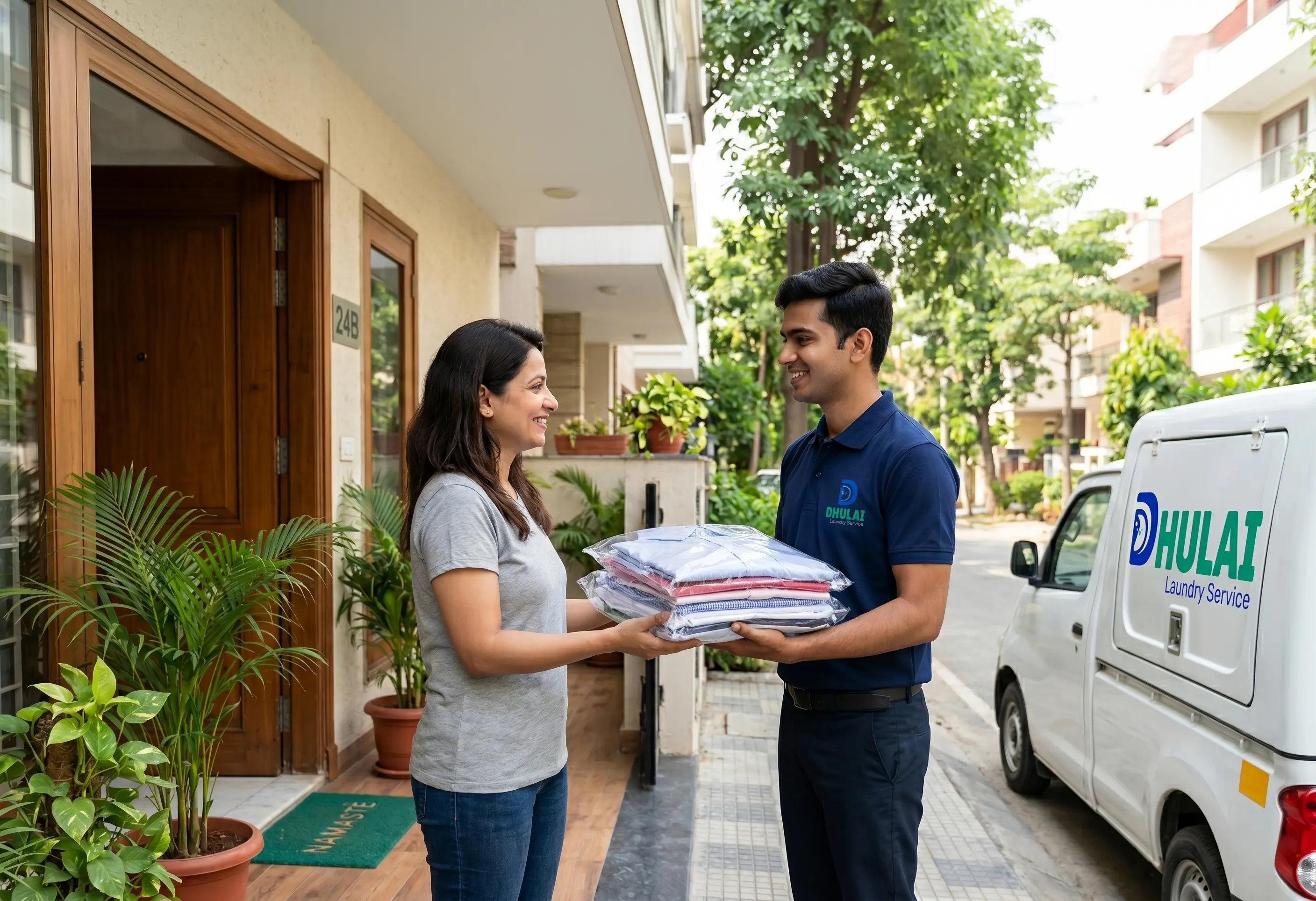
Laundry pickup and delivery in Gurugram, explained end to end: the sectors we collect from, how a doorstep order works, what you can send and what it costs...